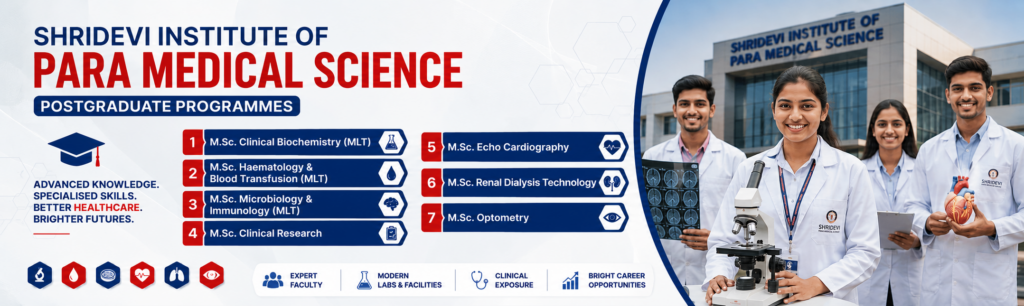
The M.Sc. in Clinical Biochemistry is an advanced 2-year postgraduate program that provides in-depth knowledge of biochemical processes and their applications in clinical diagnostics. The curriculum covers advanced enzymology, molecular biology, clinical endocrinology, and metabolic disorders, preparing students for specialized roles in medical laboratories.
Students gain hands-on experience with sophisticated analytical instruments like HPLC, mass spectrometry, and automated analyzers. The program emphasizes quality assurance, laboratory management, and the interpretation of complex biochemical data for accurate disease diagnosis.
Graduates are well-equipped to take on senior roles in hospital laboratories, research institutions, and diagnostic centers, contributing to advanced clinical research and patient care.
This specialized 2-year program focuses on the comprehensive study of blood, blood-forming organs, and blood diseases. The curriculum covers advanced hematology, coagulation disorders, immunohematology, and the principles of safe blood transfusion practices.
Students receive extensive training in bone marrow analysis, flow cytometry, and blood banking operations. The program highlights the critical importance of donor screening, component preparation, and transfusion safety protocols in modern healthcare.
Upon completion, graduates can pursue careers as senior hematology technologists, blood bank managers, and researchers in specialized hematology and oncology centers.
The M.Sc. in Microbiology & Immunology is a rigorous 2-year program designed to provide advanced knowledge of pathogenic microorganisms and the human immune system. The coursework includes clinical virology, bacteriology, mycology, parasitology, and advanced immunological techniques.
Students learn to identify and culture various pathogens, perform antimicrobial susceptibility testing, and understand the mechanisms of immune responses and vaccine development. The program includes practical training in infection control and hospital epidemiology.
Graduates are prepared for roles in clinical microbiology labs, public health organizations, pharmaceutical companies, and research institutes focused on infectious diseases and immunology.
This 2-year postgraduate program is tailored for students aspiring to build a career in the rapidly growing field of clinical research and drug development. The curriculum covers clinical trial design, pharmacovigilance, regulatory affairs, biostatistics, and medical writing.
Students learn the ethical and legal frameworks governing human research, including Good Clinical Practice (GCP) guidelines. The program provides practical exposure to data management, protocol development, and the execution of clinical trials in real-world settings.
Graduates are highly sought after by pharmaceutical companies, Contract Research Organizations (CROs), and healthcare institutions, ready to manage clinical trials and contribute to medical advancements.
The M.Sc. in Echo Cardiography is a specialized 2-year program focused on non-invasive cardiac imaging and the diagnosis of cardiovascular diseases. The curriculum covers advanced echocardiography techniques, cardiac anatomy, physiology, and hemodynamics.
Students gain extensive hands-on training in performing transthoracic and transesophageal echocardiograms, stress echocardiography, and fetal echocardiography. The program emphasizes accurate image acquisition, interpretation, and reporting in collaboration with cardiologists.
Graduates are equipped to work as senior cardiac sonographers and echocardiography specialists in heart hospitals, cardiology centers, and advanced diagnostic imaging facilities.
This advanced 2-year program provides comprehensive training in nephrology and renal replacement therapies. The curriculum covers advanced dialysis modalities, renal physiology, fluid and electrolyte balance, and the management of chronic kidney disease.
Students learn to manage complex dialysis procedures, including hemodialysis, peritoneal dialysis, and continuous renal replacement therapy (CRRT). The program also includes training in kidney transplant care and the operation of advanced water treatment plants for dialysis units.
Graduates are prepared for leadership roles in dialysis centers, nephrology departments, and medical device companies, ensuring high-quality care for patients with renal disorders.
The M.Sc. in Optometry is a 2-year postgraduate program designed to develop advanced clinical skills in eye care and vision science. The curriculum covers binocular vision, contact lens practice, low vision rehabilitation, pediatric optometry, and ocular diseases.
Students receive specialized training in advanced diagnostic techniques, including OCT, visual field testing, and electrophysiology. The program emphasizes evidence-based practice, research methodology, and the management of complex visual disorders.
Graduates are qualified to work as senior optometrists, clinical researchers, and educators in eye hospitals, optical chains, and academic institutions, contributing to advanced vision care.
The duration of the Master’s Degree in Medical Laboratory technology including submission of project work on the topic registered shall be for a period of two years from the commencement of the academic term on full time basis.
© 2025 Created with SCT All Rights Reserved.